
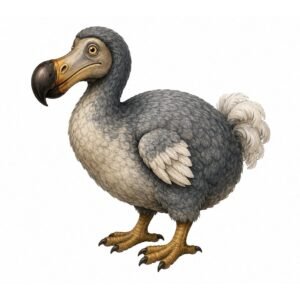
THE DODO
Raphus cucullatus
INSTITUTE CLASSIFICATION: Spectacularly Misunderstood
OFFICIAL STATUS:  REAL — EXTINCT
ARCHIVE: Ancient Creatures & Lost Legends
CASE STATUS: Investigation Complete
CASE SUMMARY
Reports describe a large, flightless bird that once lived on the island of Mauritius.
It couldn’t fly.
It apparently wasn’t particularly frightened of humans.
It disappeared less than a century after people began settling permanently on the island.
And somehow, hundreds of years later, its name became another word for:
Stupid.
The Institute considered this extremely unfair.
Case opened.
CLAIMS UNDER INVESTIGATION
CLAIM #1
The Dodo was a real bird.
CLAIM #2
It couldn’t fly.
CLAIM #3
It was stupid and clumsy.
CLAIM #4
Human activity contributed to its extinction.
Initial Institute Assessment:
Claims #1 and #2: Confirmed.
Claim #3:
The Dodo would like a lawyer.
ORIGIN & HABITAT
The Dodo lived on Mauritius, an island in the Indian Ocean east of Madagascar.
It evolved in an environment without the kinds of large mammalian predators that might otherwise have made being able to fly rather useful.
RECOGNISED BY
Researchers should look for:
Large flightless body
Powerful legs
Small wings
Large hooked bill
Short tail feathers
Being extinct since the 1600s
That final feature makes field identification considerably more difficult.
KNOWN FOR
Being extinct.
Unfortunately.
The Dodo has become one of the world’s great symbols of extinction, but its reputation as a hopelessly stupid bird is misleading.
It was an animal adapted to its island environment.
Then that environment changed dramatically.
And quickly.
WHAT THE EVIDENCE SAYS
The Dodo was unquestionably real.
We know this from historical accounts, drawings and physical remains.
It was also flightless.
But the popular image of the Dodo as an absurdly stupid creature is largely a human story rather than a scientific conclusion.
Human hunting played a role in its decline, while introduced animals such as pigs, rats and monkeys disrupted its habitat and could prey upon eggs and young.
By the late 17th century, the Dodo was gone.
INSTITUTE FIELD NOTES
FIELD ASSIGNMENT: Locate living Dodo.
Day 1
Mauritius searched.
No Dodo.
Day 2
Additional searching.
No Dodo.
Day 3
Researcher reports possible Dodo.
Subject identified as chicken.
Chicken appears offended.
CONCLUSION: Historical evidence excellent.
Current Dodo population:
Zero.
FUN FACTS
The Dodo was related to pigeons and doves.
It evolved on Mauritius.
It was flightless.
It disappeared during the 1600s.
It has become one of the best-known extinct animals in history.
Despite this, nobody alive has ever seen one.
Institute researchers consider this an impressive publicity strategy.
OFFICIAL FINDING
REAL — EXTINCT
The Dodo existed.
The evidence is overwhelming.
But the living bird has disappeared forever.
The Institute therefore recommends replacing:
“Dead as a Dodo.”
with:
“Please look after the wildlife while it’s still here.”
JUNIOR RESEARCHER CHALLENGE
Investigate the Dodo’s extinction.
What changed after humans arrived on Mauritius?
And what can the story of the Dodo teach us about protecting endangered animals today?