
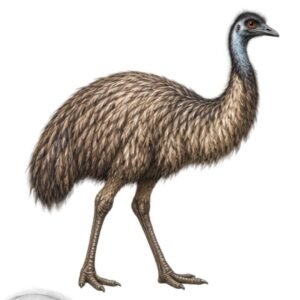
THE EMU
Dromaius novaehollandiae
INSTITUTE CLASSIFICATION: Heavily Armed Jogger
OFFICIAL STATUS:  REAL
REAL
ARCHIVE: Avian Behaviour Department
CASE STATUS: Investigation Complete
CASE SUMMARY
Reports from across Australia describe an enormous flightless bird capable
of running at considerable speed, swimming when necessary and defending itself with powerful legs.
It cannot fly.
It does, however, have wings.
Very small wings.
The male also takes responsibility for incubating the eggs and raising the chicks.
And, in 1932, a group of emus became involved in an incident now commonly known as:
The Great Emu War.
The Institute opened a file immediately.
CLAIMS UNDER INVESTIGATION
CLAIM #1
Emus are Australia’s second-largest living bird.
CLAIM #2
They can run at around 50 km/h.
CLAIM #3
Male emus incubate the eggs and care for the chicks.
CLAIM #4
The Australian military was once deployed during an operation involving large numbers of emus.
Initial Institute Assessment:
Claims #1–3 seem reasonable.
Claim #4 appears to have escaped from an Institute Original.
Investigation authorised.
ORIGIN & HABITAT
Emus are native to Australia and occur across much of the mainland.
They inhabit grasslands, woodlands, open country and other environments
where having very long legs and being able to travel considerable distances comes in handy.
RECOGNISED BY
Tall flightless body
Long powerful legs
Shaggy brown-grey feathers
Long neck
Three-toed feet
Extremely small wings
Expression suggesting it knows something you don’t
KNOWN FOR
Running.
Emus have powerful legs and can reach impressive speeds.
They can also swim.
Their tiny wings play a role in balance and movement but are utterly inadequate for getting an adult emu airborne.
The Institute has examined them.
There will be no take-off.
WHAT THE EVIDENCE SAYS
Emus are remarkable even without the Great Emu War.
They are among the world’s largest living birds and are superbly adapted to travelling across the Australian landscape.
Perhaps most interestingly, Dad does the parenting.
After the female lays the eggs, the male incubates them for roughly eight weeks. During this period he eats very little.
Once the chicks hatch, he protects and raises them for months.
Institute Parenting Department assessment:
Excellent work, Dad.
INCIDENT REPORT: THE GREAT EMU WAR
In 1932, large numbers of emus moved into farming areas in Western Australia, damaging crops.
Military personnel equipped with machine guns were sent to help reduce their numbers.
The operation did not proceed quite as planned.
The emus scattered.
Equipment caused problems.
Thousands of birds remained.
The military operation was eventually discontinued.
The birds did not actually declare war.
They didn’t sign a peace treaty either.
The Institute therefore records the result as:
Emus: Still present.
INSTITUTE FIELD NOTES
FIELD NOTE #61
6:14 am — Emu observed.
6:15 am — Researcher approaches.
6:15:04 am — Emu begins running.
6:15:05 am — Researcher begins running.
6:15:11 am — Researcher remembers emus can run approximately 50 km/h.
6:15:12 am — Researcher stops running.
CONCLUSION: Binoculars recommended.
FUN FACTS
Emus are flightless.
They have tiny wings.
They can run at impressive speeds.
They are capable swimmers.
Males incubate the eggs.
Males care for the chicks after hatching.
Emus appear on the Australian Coat of Arms.
They have yet to comment publicly on the 1932 incident.
OFFICIAL FINDING
REAL
Giant running bird?
Real.
Tiny wings?
Real.
Swimming?
Real.
Dad sitting on the eggs?
Real.
Great Emu War?
Also real — although considerably more complicated than the name suggests.
Reality wins again.
JUNIOR RESEARCHER CHALLENGE
Compare an Emu with another flightless bird.
Try a:
Cassowary • Ostrich • Kiwi • Penguin
What adaptations do they share?
What makes each one different?