CASSOWARY
Casuarius
INSTITUTE CLASSIFICATION: Rainforest Safety Inspector
OFFICIAL STATUS:  REAL
REAL
ARCHIVE: Avian Behaviour Department
CASE STATUS: Investigation Complete
CASE SUMMARY
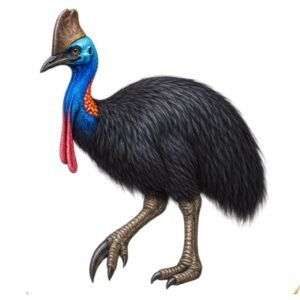
Reports from tropical rainforests describe a large flightless bird with brilliant blue skin,
a strange helmet on its head and powerful legs equipped with formidable claws.
It eats fruit.
Disperses seeds.
Helps maintain rainforest ecosystems.
And looks as though somebody has combined:
A turkey, a dinosaur and a medieval weapon.
Institute researchers suspected exaggeration.
They were mistaken.
CLAIMS UNDER INVESTIGATION
CLAIM #1
Cassowaries are large flightless rainforest birds.
CLAIM #2
They have a helmet-like structure on their heads.
CLAIM #3
Their feet possess powerful claws.
CLAIM #4
Cassowaries play an important role in rainforest ecosystems by spreading seeds.
Initial Institute Assessment:
Claims #1–3 sound concerning.
Claim #4 makes us feel slightly guilty about Claims #1–3.
ORIGIN & HABITAT
Cassowaries occur in New Guinea and nearby islands, with the Southern Cassowary also found
in the tropical rainforests of northeastern Australia.
Dense rainforest is their speciality.
RECOGNISED BY
Large black-feathered body
Brilliant blue neck and head
Red wattles in some species
Helmet-like casque
Powerful legs
Three-toed feet
Large inner claw
KNOWN FOR
Looking dangerous.
But ecologically, one of the cassowary’s most important jobs is considerably less dramatic:
Eating fruit.
Cassowaries swallow fruits and later deposit the seeds elsewhere.
Some rainforest plants benefit greatly from cassowaries moving their seeds around the forest.
The Institute therefore recognises the cassowary as:
Large, intimidating rainforest gardener.
WHAT THE EVIDENCE SAYS
Cassowaries are powerful animals and should always be treated with respect.
But their reputation as constantly aggressive “killer birds” is misleading.
They generally prefer to avoid people.
Problems can occur when birds become accustomed to humans, particularly through feeding, or when they feel threatened.
Their claws are defensive equipment.
Not an invitation to test your running speed.
INSTITUTE FIELD NOTES
RAINFOREST OBSERVATION
9:03 am — Cassowary located.
9:04 am — Researcher notes enormous feet.
9:05 am — Researcher notes enormous claws.
9:06 am — Cassowary looks toward researcher.
9:06:01 am — Researcher decides observations can continue from considerably farther away.
9:07 am — Fruit consumed.
9:13 am — Cassowary disappears into rainforest.
CONCLUSION: Magnificent animal.
Excellent seed disperser.
Distance appreciated.
INSTITUTE SAFETY NOTE
If you encounter a wild cassowary:
Give it plenty of space.
Never feed it.
Don’t approach chicks.
Don’t attempt to touch it.
Allow the bird a clear route away.
Follow local wildlife guidance.
Junior Researchers should observe wildlife without disturbing it.
FUN FACTS
Cassowaries cannot fly.
Their casque continues growing as they mature.
They eat large quantities of fruit.
They can disperse seeds over considerable distances.
Male cassowaries incubate eggs and care for chicks.
Their rainforest role makes them important to the ecosystems they inhabit.
OFFICIAL FINDING
REAL
Colourful dinosaur-looking rainforest bird?
Real.
Helmet?
Real.
Large claws?
Very real.
Important rainforest seed disperser?
Absolutely real.
The Institute recommends admiration from an appropriate distance.
JUNIOR RESEARCHER CHALLENGE
Investigate seed dispersal.
Why would a plant benefit from an animal eating its fruit and carrying the seeds somewhere else?
Then investigate three different ways plants move their seeds.