
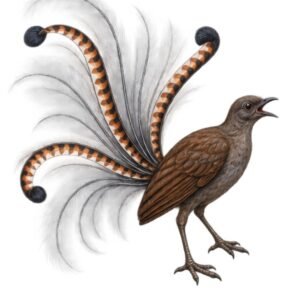
LYREBIRD
Menura
INSTITUTE CLASSIFICATION: Suspiciously Talented Impressionist
OFFICIAL STATUS:  REAL
REAL
ARCHIVE: Avian Behaviour Department
CASE STATUS: Investigation Complete
CASE SUMMARY
Reports from Australian forests describe a bird capable of producing an astonishing range of sounds.
Other birds.
Animals.
Environmental noises.
And occasionally sounds that seem to have absolutely no business coming from a bird.
Institute researchers heard the reports and immediately suspected:
The Liarbird.
This was embarrassing.
The creature was actually a:
Lyrebird.
And this one was real.
CLAIMS UNDER INVESTIGATION
CLAIM #1
Lyrebirds can imitate other birds.
CLAIM #2
They can reproduce an extraordinary variety of sounds.
CLAIM #3
Male Superb Lyrebirds perform elaborate displays using their remarkable tails.
CLAIM #4
Some lyrebirds have been reported mimicking human-made sounds.
Initial Institute Assessment:
Either extraordinary vocal mimicry…
Or somebody has hidden a speaker in the forest.
ORIGIN & HABITAT
Lyrebirds are native to Australia.
The two living species are the Superb Lyrebird and Albert’s Lyrebird.
They inhabit forests and other densely vegetated environments in eastern Australia.
RECOGNISED BY
Ground-dwelling appearance
Strong legs
Excellent scratching ability
Extraordinary vocalisations
Elaborate tail feathers in adult male Superb Lyrebirds
Suspicious noises coming from somewhere nearby
KNOWN FOR
Being among the world’s most extraordinary avian mimics.
Lyrebirds can incorporate the calls of other bird species into their performances.
Males also use complex songs and displays during courtship.
The famous tail of the male Superb Lyrebird can be spread and raised during display.
The Institute describes the overall performance as:
Needlessly impressive.
WHAT THE EVIDENCE SAYS
The Lyrebird’s mimicry is genuine.
It can learn and reproduce a remarkable variety of sounds, particularly those of other birds.
There are also famous recordings of captive or human-exposed lyrebirds apparently reproducing human-made sounds.
However, this has sometimes been exaggerated into the idea that every wild lyrebird routinely imitates chainsaws, cameras and car alarms.
The evidence is more nuanced.
Which is precisely why the Institute investigates claims instead of simply repeating them.
INSTITUTE FIELD NOTES
FIELD CROSS — COOPS
7:41 am — Lyrebird call heard.
7:43 am — Additional bird call heard from same location.
7:44 am — Third species apparently heard.
7:46 am — Coops reports:
“There must be twenty birds in there.”
7:48 am — One Lyrebird located.
7:49 am — Coops requests recount.
FUN FACTS
Lyrebirds are native to Australia.
They spend considerable time on the ground.
They use powerful feet to scratch through leaf litter.
They are superb vocal mimics.
Males perform elaborate courtship displays.
The Superb Lyrebird’s tail is one of the most distinctive in the bird world.
IMPORTANT INSTITUTE WARNING
The Lyrebird should not be confused with the Liarbird.
The Lyrebird:
Copies sounds.
The Liarbird:
Provides extremely confident directions to places it has never visited.
One is scientifically recognised.
The other has caused repeated problems for Field Researcher Coops.
OFFICIAL FINDING
REAL
Mimicry?
Real.
Elaborate courtship performance?
Real.
Magnificent tail?
Real.
Every wild Lyrebird routinely impersonating chainsaws?
Question the claim.
The creature itself, however, is unquestionably:
REAL.
JUNIOR RESEARCHER CHALLENGE
Spend five quiet minutes listening outside.
Don’t look for animals initially.
Just listen.
How many different sounds can you identify?
Which are:
Animals? People? Machines? Wind? Water? Unknown?
Observation doesn’t always begin with your eyes.