
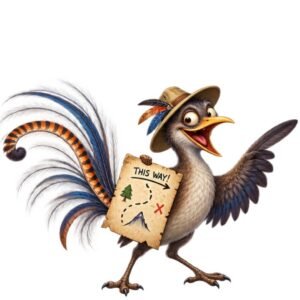
LIARBIRD
Falsiloquus confidentius
INSTITUTE CLASSIFICATION: Unreliable Avian Informant
OFFICIAL STATUS:  INSTITUTE ORIGINAL
ARCHIVE: Institute Originals
CASE STATUS: Investigation Ongoing
CASE SUMMARY
Institute researchers first became suspicious of the Liarbird after several field teams reported receiving
extremely confident directions from an unidentified bird.
The directions were clear.
Detailed.
And completely wrong.
Unlike the Lyrebird, which accurately imitates sounds, the Liarbird specialises in
providing information it appears to have invented moments earlier.
It has directed researchers toward rivers that don’t exist.
Claimed to have personally seen a Tasmanian tiger that morning.
And once sent Field Researcher Coops 3.7 kilometres outside the designated search area.
When questioned, the bird replied:
“That’s exactly where I meant to send him.”
Case opened.
CLAIMS UNDER INVESTIGATION
CLAIM #1
The Liarbird deliberately provides false information.
CLAIM #2
It becomes more confident when it knows less.
CLAIM #3
It can imitate sounds to support its stories.
CLAIM #4
It has absolutely no idea where it is.
Initial Institute Assessment:
Claim #4 currently has the strongest evidence.
ORIGIN & HABITAT
Reported in forests, parks, walking tracks and anywhere somebody has stopped to ask:
“Excuse me, do you know which way?”
Exact distribution remains uncertain.
Every time researchers ask a Liarbird where it lives, they receive a different answer.
RECOGNISED BY
Bird-like appearance
Extremely confident expression
Constant unsolicited advice
Elaborate stories
Suspiciously specific directions
Frequent use of the phrase:
“Trust me.”
KNOWN FOR
Giving directions.
Badly.
A typical encounter may proceed as follows:
RESEARCHER: Which way to the river?
LIARBIRD: Left at the big tree.
RESEARCHER: Which big tree?
LIARBIRD: You’ll know it.
RESEARCHER: Have you actually been to the river?
LIARBIRD: Constantly.
There is no river.
WHAT THE EVIDENCE SAYS
No recognised bird species called the Liarbird appears in scientific records.
Researchers have found no biological evidence supporting its existence.
However, Headquarters has accumulated:
Incorrect maps
Contradictory eyewitness reports
Several recordings
One completely unnecessary compass
A very annoyed Field Researcher Coops
The Institute therefore considers the creature:
Scientifically unsupported but operationally inconvenient.
INSTITUTE FIELD NOTES
FIELD REPORT — COOPS
8:04 am — Liarbird located.
8:06 am — Asked bird for directions to observation site.
8:07 am — Told to follow creek north.
8:42 am — No creek.
9:11 am — No observation site.
9:37 am — HQ advises researcher is 3.7 kilometres outside search area.
9:39 am — Liarbird contacted by radio.
Bird replies:
“Shortcut.”
FUN FACTS
Has never admitted to being lost.
Frequently begins sentences with “Actually…”
Claims to know Bigfoot personally.
Once reported seeing a Phoenix at a bus stop.
Has provided three different dates of birth.
Insists all three are correct.
INSTITUTE SAFETY TIPS
If approached by a Liarbird:
DO:
Check your map.
Verify the information.
Consult another source.
DO NOT:
Ask for directions.
Ask where Bigfoot lives.
Ask what time the train leaves.
Say, “Are you sure?”
It is always sure.
OFFICIAL FINDING
INSTITUTE ORIGINAL
No verified species.
No specimen.
No DNA.
No reliable evidence.
An enormous quantity of unreliable evidence.
The Liarbird is therefore officially classified:
INSTITUTE ORIGINAL.
Directions provided by the subject should not be used for navigational purposes.
JUNIOR RESEARCHER CHALLENGE
The Liarbird presents an important research problem:
How do you know whether information is reliable?
Choose a claim and check it using two or three different trustworthy sources.
Did they agree?
What made one source more reliable than another?