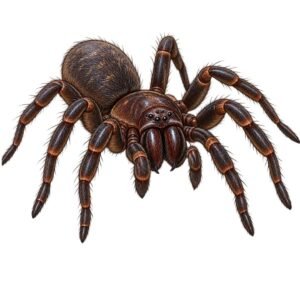
THE TRAPDOOR SPIDER
Mygalomorphae
INSTITUTE CLASSIFICATION: Underground Ambush Specialist
OFFICIAL STATUS:  REAL
REAL
ARCHIVE: Forest & Backyard Creatures
CASE STATUS: Investigation Complete
CASE SUMMARY
Institute Headquarters received reports of something unusual happening beneath our feet.
Small holes had appeared in the ground.
Insects were disappearing.
And some of those holes appeared to have doors.
Researcher Mia Sullivan was dispatched to investigate.
What she discovered was not an underground bunker, tiny secret headquarters or extremely small property development.
It was a spider.
CLAIMS UNDER INVESTIGATION
CLAIM #1
Some spiders live underground.
CLAIM #2
They construct burrows with hidden doors.
CLAIM #3
They wait inside and ambush passing prey.
Initial Institute Assessment:
A spider with its own front door sounds suspiciously organised.
Investigation authorised.
ORIGIN & HABITAT
Trapdoor spiders are found in different parts of the world, including Australia.
They generally live in burrows dug into soil, often in places where vegetation and leaf litter help conceal the entrance.
Which is rather the point. You’re not supposed to see them.
RECOGNISED BY
Researchers should look for:
A sturdy spider body
Eight legs
Powerful jaws
An underground burrow
A carefully disguised entrance
A distinct reluctance to answer the door
KNOWN FOR
Building one of the best concealed homes in the spider world.
Many trapdoor spiders construct burrows and camouflage the entrance
using materials such as soil, leaves and silk.
The spider waits inside for potential prey to approach.
Then — SURPRISE.
The spider rushes from its burrow, grabs the prey and retreats underground.
Institute researchers describe this as:
“Ambush predation.”
The Trapdoor Spider describes it as:
“Home delivery.”
WHAT THE EVIDENCE SAYS
Trapdoor spiders are completely real.
Different species build different types of burrows, and not every trapdoor spider
creates exactly the same kind of hinged “door”.
But the extraordinary behaviour behind the claim is genuine.
They can:
Dig underground burrows
Use silk around their retreats
Camouflage burrow entrances
Detect prey moving nearby
Rush from concealment to capture prey
Suddenly the Institute’s disappearing-insect problem was beginning to make considerably more sense.
*INSTITUTE SAFETY NOTE
Trapdoor spiders should be observed, not handled or disturbed.
Junior Researchers should never poke fingers, sticks or other objects into spider burrows.
If you discover a possible trapdoor spider burrow:
Observe it from a respectful distance.
Take a photograph if it can be done without disturbing the animal.
Record what you notice.
Leave the resident alone.
OFFICIAL FINDING
REAL
After examining the evidence, the Institute confirms:
Spiders really do live underground.
Some really do construct concealed burrows.
And some really do wait inside for dinner to walk past their front door.
Case classification: REAL.
JUNIOR RESEARCHER CHALLENGE
What animals live beneath the ground around your home, school or local park?
Without disturbing any burrows or animals, look for signs such as:
Holes
Webbing
Tracks
Shed skins
Disturbed soil
Leaf litter
Other evidence of animal activity
Observe. Don’t disturb. Record what you discover.
CONTINUE THE INVESTIGATION
 HEAR THE INVESTIGATION
The Trapdoor Spider investigation appears in Episode One of Extremely Questionable Creatures Podcast
 DOWNLOAD THE CREATURE INVESTIGATION WORKSHEET
 OPEN YOUR OWN INVESTIGATION
INTERNATIONAL INSTITUTE FOR THE STUDY OF EXTREMELY QUESTIONABLE CREATURES
All creatures are presumed interesting until proven otherwise.