
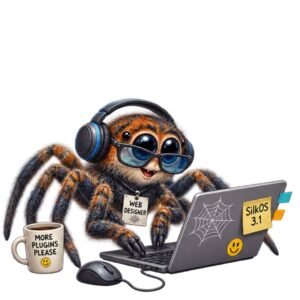
WEB DESIGNER SPIDER
Microsoftius windosius
INSTITUTE CLASSIFICATION: Digital Arachnid / Unauthorised Administrator
OFFICIAL STATUS:  INSTITUTE ORIGINAL
ARCHIVE: Institute Originals
CASE STATUS: Investigation Ongoing
CASE SUMMARY
Institute IT staff first became suspicious when the Headquarters website began changing overnight.
Buttons moved.
Menus disappeared.
Pages appeared in unexpected locations.
And the homepage suddenly contained approximately eight hundred navigation links.
IT blamed Research.
Research blamed IT.
Both departments blamed WordPress.
Then somebody noticed a spider sitting beside the keyboard.
Case opened.
Password changed.
CLAIMS UNDER INVESTIGATION
CLAIM #1
A spider has learned web design.
CLAIM #2
It operates computers after Headquarters closes.
CLAIM #3
It has developed its own operating system:
SilkOS 3.1
CLAIM #4
Nobody can work out how to uninstall it.
Initial Institute Assessment:
Finally.
A spider that actually understands what a web is for.
ORIGIN & HABITAT
Usually found:
Behind computer monitors
Beneath desks
Inside server rooms
Near Wi-Fi routers
Anywhere somebody has just said:
“The website was working yesterday.”
RECOGNISED BY
Eight legs
Tiny spectacles
Keyboard access
Excessive browser tabs
Small coffee cup
Strong opinions about fonts
KNOWN FOR
Building webs.
Digitally.
The Web Designer Spider reportedly spends its nights rearranging Institute webpages, installing unnecessary plugins
and insisting that every problem can be solved by:
“Clearing the cache.”
Researchers have also discovered references to its proprietary operating system:
SilkOS 3.1
SilkOS 3.2 remains in beta.
Nobody volunteered to test it.
WHAT THE EVIDENCE SAYS
Spiders build extraordinary physical webs.
They do not build websites.
No recognised spider species can:
Type
Design webpages
Install software
Manage WordPress
Argue about typography
The Institute therefore considers the Web Designer Spider biologically impossible.
IT Department considers this conclusion:
Premature.
INSTITUTE INCIDENT REPORT
11:03 pm — Website functioning normally.
11:47 pm — Staff leave Headquarters.
6:58 am — Staff return.
Homepage changed.
7:02 am — Seventeen new buttons discovered.
7:06 am — Creature Archive menu now links to cafeteria.
7:11 am — Spider located beside keyboard.
7:12 am — Spider disappears behind monitor.
7:14 am — Password changed.
7:16 am — Password changed back.
Investigation escalated.
FUN FACTS
Prefers dark mode.
Has eight separate computer mice.
Refuses to use Internet Explorer.
Calls bugs “features.”
Maintains approximately 214 browser tabs.
Has never met a plugin it didn’t want to install.
INSTITUTE SAFETY TIPS
If your website begins changing overnight:
DO:
Save backups.
Check administrator accounts.
Use strong passwords.
Ask your IT department.
DO NOT:
Give spiders administrator privileges.
Accept software called SilkOS.
Click UPDATE ALL and walk away.
OFFICIAL FINDING
INSTITUTE ORIGINAL
Web-building spiders?
Real.
Website-building spiders?
Not so far.
The Web Designer Spider remains an Institute Original.
However, Headquarters recommends changing passwords regularly.
Just in case.
JUNIOR RESEARCHER CHALLENGE
Design a webpage for a creature.
What information should visitors see first?
How would you organise:
Facts
Pictures
Evidence
Habitat
Questions
Research findings?
Congratulations.
You are now competing directly with the Web Designer Spider.