
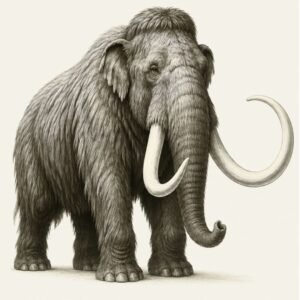
WOOLLY MAMMOTH
Mammuthus primigenius
INSTITUTE CLASSIFICATION: Extremely Shaggy Ice-Age Elephant
OFFICIAL STATUS:  REAL — EXTINCT
ARCHIVE: Ancient Creatures & Lost Legends
CASE STATUS: Investigation Complete
CASE SUMMARY
Imagine an elephant.
Now add an enormous coat.
Smaller ears.
Long curved tusks.
And place it somewhere so cold that even the Institute’s field researchers would refuse to get out of the vehicle.
You have a Woolly Mammoth.
Unlike many creatures in the Ancient Creatures Archive, we don’t just have fossilised bones.
Some mammoths have been preserved astonishingly well in frozen ground.
Hair.
Skin.
Soft tissues.
Even stomach contents.
The Institute considers this excessive evidence.
CLAIMS UNDER INVESTIGATION
CLAIM #1
Woolly Mammoths were real.
CLAIM #2
They were adapted to extremely cold environments.
CLAIM #3
Humans lived alongside them.
CLAIM #4
Some Woolly Mammoths survived until surprisingly recently.
Initial Institute Assessment:
Large hairy elephant?
Strangely reasonable.
ORIGIN & HABITAT
Woolly Mammoths lived across cold regions of Europe, Asia and North America during the Pleistocene.
They were particularly suited to the cold, dry grassland environments often called the mammoth steppe.
RECOGNISED BY
Thick shaggy coat
Long curved tusks
Elephant-like body
Small ears
Fat reserves beneath the skin
Complete absence from modern zoos
KNOWN FOR
Being one of the great icons of the Ice Age.
Their thick coats, body fat and other adaptations helped them survive bitterly cold environments.
And unlike dinosaurs, Woolly Mammoths actually lived alongside humans.
WHAT THE EVIDENCE SAYS
Woolly Mammoths were unquestionably real.
Scientists have found:
Bones
Tusks
Teeth
Frozen remains
Ancient DNA
Human artwork depicting mammoths
Most Woolly Mammoth populations disappeared thousands of years ago,
although isolated populations survived much longer on islands.
Their extinction probably involved a combination of environmental change and
human pressures rather than one simple cause.
INSTITUTE FIELD NOTES
FIELD REP #27
Large hairy animal reported.
Researcher dispatched.
Temperature:
-23°C.
Researcher returned to vehicle.
Further investigation conducted through binoculars.
Subject later identified as:
Yak.
Researcher maintains decision to remain in vehicle was scientifically justified.
FUN FACTS
Woolly Mammoths were closely related to modern elephants.
Their ears were smaller than those of many modern elephants, helping reduce heat loss.
Their tusks could grow extremely long and curved.
Frozen specimens have preserved hair and other soft tissue.
Humans painted and carved images of mammoths.
The last isolated populations survived thousands of years after most mainland mammoths disappeared.
OFFICIAL FINDING
REAL — EXTINCT
Hairy elephant:
Confirmed.
Giant curved tusks:
Confirmed.
Ice Age existence:
Confirmed.
Living Woolly Mammoth:
Not confirmed.
The Institute would nevertheless like everyone to keep an eye on particularly hairy elephants.
JUNIOR RESEARCHER CHALLENGE
Design an Ice Age Survival Kit for a mammal.
What adaptations would your animal need to survive:
Freezing temperatures?
Snow?
Strong winds?
Limited food?
Then compare your design with the adaptations of the Woolly Mammoth.